
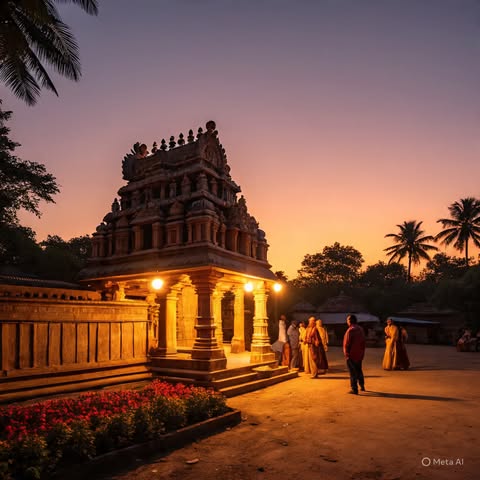

In many Tamil villages, the day does not end with sunset. It reorganises itself. As work winds down and heat recedes, people begin moving outward — from homes to shared spaces. Among these spaces, the village temple occupies a central role. Not always as a place of ritual, but as a gathering point where social life resumes quietly.
Evening temple hours are rarely dramatic. There are no processions, no announcements, no urgency. Lamps are lit slowly. Bells ring softly. The priest performs the final rituals of the day with minimal audience. Yet around the temple, something larger unfolds. Men sit on steps discussing crops, prices, local politics. Women exchange updates about families and upcoming events. Children run freely, watched collectively rather than individually.
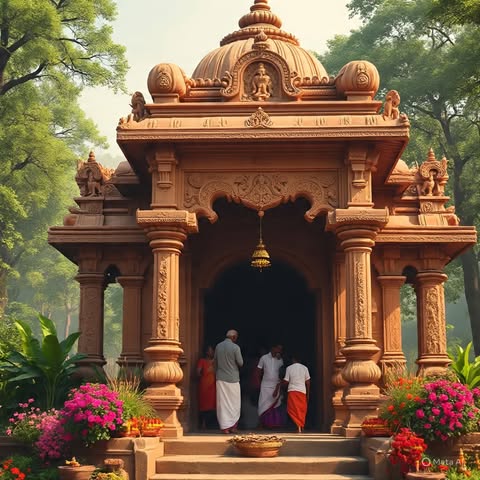
This rhythm has existed long before formal community halls or recreational spaces. The temple courtyard functioned as neutral ground. Attendance did not require devotion. One could sit outside, observe, listen, participate lightly. The temple did not demand explanation.
Unlike morning rituals, which carry personal intention, evening temple presence is social by nature. People arrive without offerings, without urgency. The act of being present matters more than participation. For elders, it provides continuity — a place to be seen and acknowledged daily. For younger adults, it offers informal networking. For children, it establishes familiarity with shared space.
These evenings also serve as information exchanges. News travels here first — who fell sick, whose child got a job, which family plans a wedding. Long before messaging apps, this was how villages stayed informed. Even today, digital communication supplements rather than replaces these encounters.
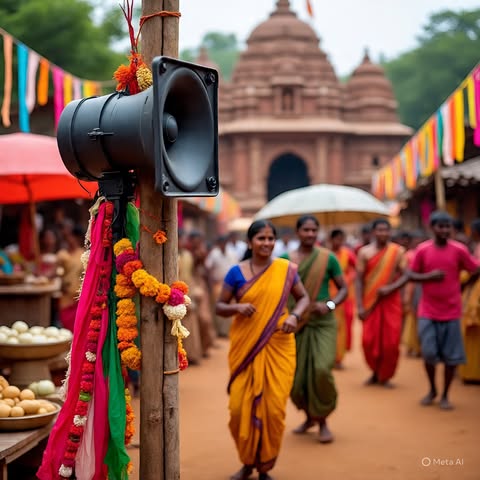
The sounds of evening temples are subtle. Conversations overlap. A radio plays faintly nearby. Occasionally, devotional songs drift through speakers. Unlike festival days, sound does not dominate. It blends into routine.
Urbanisation has altered village evenings, but not erased them. Migration has reduced daily attendance. Some evenings feel thinner. Yet when people return — during holidays, festivals, or personal transitions — the temple reclaims its role immediately. Familiar faces resume old positions without instruction.
Women’s participation in evening temple spaces varies by region and generation. In some villages, women dominate the space; in others, presence is limited by household responsibilities. Over time, these boundaries have softened. More women now linger, converse, and claim space. Change here is slow, but visible.
We avoid romanticising village life. Conflicts exist here too — caste tensions, political disagreements, generational divides. The temple does not erase these realities. But it offers a platform where differences coexist without immediate confrontation. Shared space creates tolerance through proximity.
As rural infrastructure modernises, new gathering spaces emerge — tea shops, community halls, sports grounds. Yet the temple remains distinct. It does not belong to any single group. Its authority comes from age, repetition, and shared memory.
Documenting village temple evenings is not an attempt to preserve a static past. It is an effort to recognise a social system that still functions quietly. As long as people continue to step outside at dusk and move toward shared spaces, this rhythm survives.
Comments / கருத்துக்கள்
No comments yet. Be the first to comment!
Leave a comment